researchMay 2026

Your Biggest Marketing Moments May Be Invisible to AI

A before/after study into whether LLMs notice enterprise marketing events — and what actually determines if they do.

E
Evolv Agency · Evolv Agency

The Problem Nobody Is Measuring

The Reality

Companies spend six figures on conferences. PR teams land coverage in TechTarget, The Register, and NetworkWorld. Announcements hit dozens of publications in a 72-hour window.

But nobody knows if LLMs notice — not consistently, not measurably, not in a way enterprise teams can act on.

The Gap

Most organisations tracking AI visibility are operating in the dark — watching scores move and guessing at the cause. When visibility increases after an event, was it the event itself? The press coverage? A model update? Or just noise?

We tested it. This is what we found.

The Experiment

In April 2026, we measured LLM visibility before and after a major enterprise technology conference — a three-day event with multiple product announcements, tier-1 press coverage, and a significant pre-event PR campaign.

Pre & Post Scores

Visibility scores captured across five models: Perplexity AI (Sonar), ChatGPT, Google Gemini (training data and grounded), and Claude — before and within 48 hours of the event closing.

Citation Source Exports

Full citation source exports for four topics directly tied to conference announcements, plus Google Search Console data covering the same period.

Net-New Topics

A clean set of four net-new topics with no prior citation history — meaning any citations appearing post-event were directly attributable to the event window.

The result: yes — LLMs noticed. But which models noticed, how fast, and why revealed something far more useful than a headline score change.

Finding One: Visibility is Model-Dependent, Not Universal

What Moved

+36

Points On the vendor's most commercially important topic within 48 hours — on Perplexity (Sonar)

+7.8

Avg Movement Average topic movement across event-themed topics on Perplexity

+9.0

Parity Gain Competitive parity achieved on a topic where a major incumbent had previously led

ChatGPT

Flat

Gemini (Training Data)

Flat

Claude

Flat

If you're measuring event impact in training-data models, you're measuring history — not visibility. You're looking at the wrong system on the wrong timeline.

The LLM Citation Supply Chain

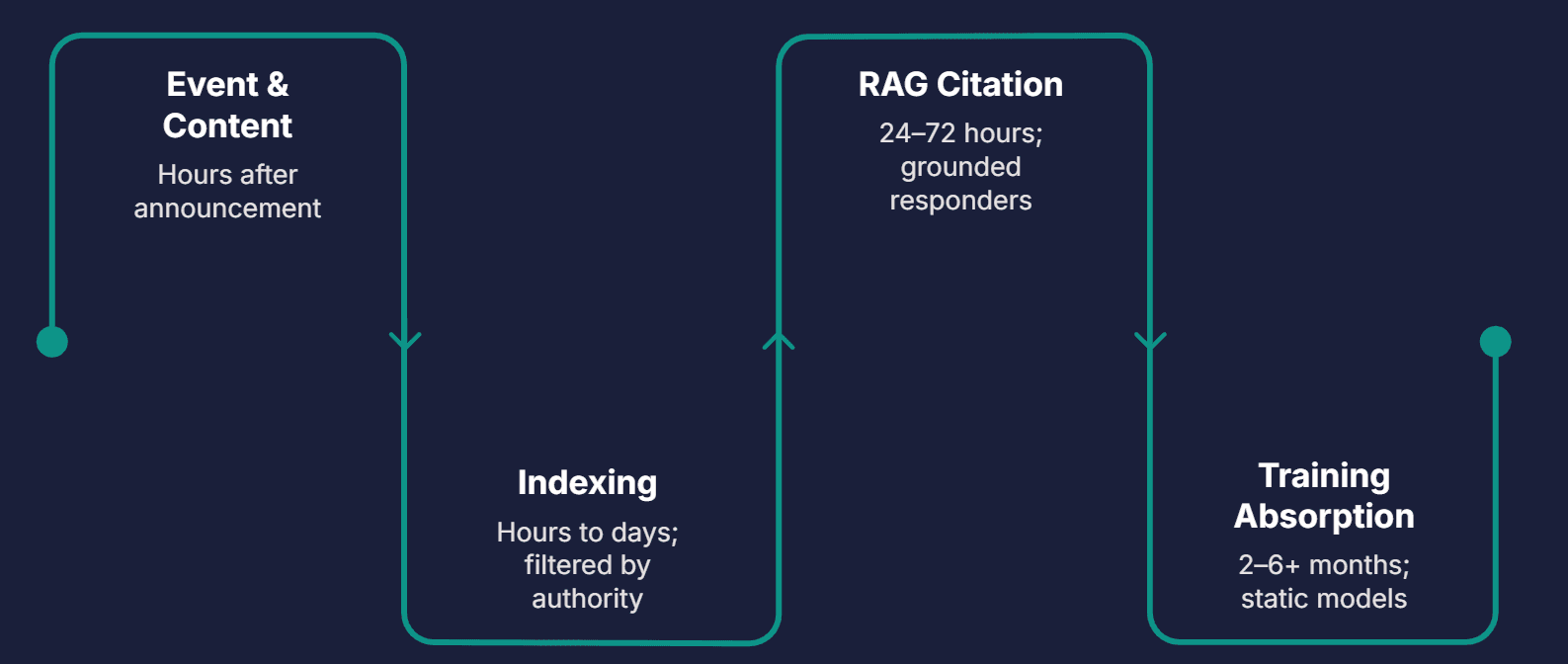
To understand why some models moved and others didn't, you need to understand how information actually reaches LLMs. This four-stage system governs how a real-world event becomes — or fails to become — an LLM citation.

The LLM Citation Supply Chain

LLMs don't observe events. They observe what trusted sources say about them — and only after those sources have passed through multiple layers of selection. This is why Perplexity moved within 48 hours while training-data models remained flat.

Finding Two: Not All Coverage Carries Equal Weight

We captured 37 new citations across four topics in the post-event window. Impact was not driven by volume — it was driven by source quality and whether multiple sources independently corroborated the same narrative.

Tier 1 — Moves the Dial

TechTarget, SiliconAngle, NetworkWorld, The Register. A single Tier 1 editorial outweighed multiple lower-tier placements. One TechTarget piece generated more score movement than five syndicated wire items combined.

Tier 2 — Builds Redundancy

GlobeNewswire, PRNewswire, DevOpsDigest, TechZine.eu, regional publications. Doesn't move scores individually — but creates the consensus signal that tells retrieval systems the event was real and significant.

Tier 3 — Baseline, Not Driver

Vendor blog posts, documentation, press pages. Low incremental impact. An LLM already knows your company exists — your own content confirming your event doesn't carry the weight of independent editorial.

The strongest visibility gains occurred at the intersection of all three tiers. This is not a PR volume problem. It's a citation architecture problem.

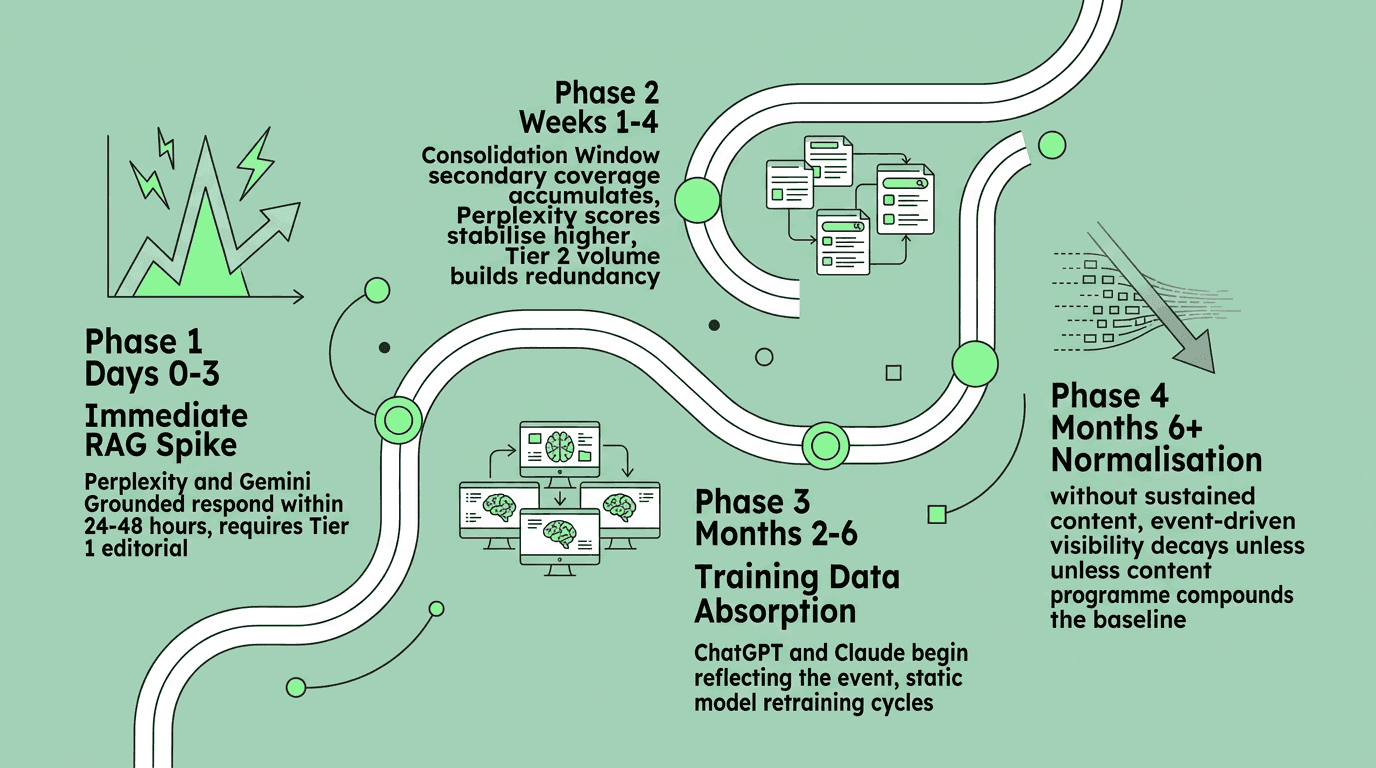
Finding Three: The Event Citation Propagation Curve

Finding Three: The Event Citation Propagation Curve

Key insight: A conference doesn't create visibility. It accelerates whatever citation architecture already exists. The content programme that follows determines whether the spike compounds into a lasting baseline shift or reverts.

Finding Four: Organic Search and LLM Visibility Are the Same System

The Data Alignment

2x

Search Clicks Branded event query clicks doubled in the 28-day window vs. the prior period

100%

Topic Overlap Pages gaining organic search traffic were the same topics gaining LLM citations

Two independent measurement systems — LLM visibility tracking and Google Search Console — pointed in the same direction simultaneously. That's not coincidence.

The Integration Insight

SEO and LLM visibility are not separate disciplines. They are downstream outputs of the same upstream input:** high-quality earned media in high-authority publications.**

A single TechTarget editorial does three things at once: generates referred traffic, builds backlink authority for traditional search, and enters the LLM Citation Supply Chain. The investment is the same; the returns are multiplied.

Enterprise teams treating 'LLM optimisation' as a separate workstream from PR and SEO are solving an integration problem they've created themselves.

What This Means for Event Strategy

Pre-Event Is Foundational

Pre-event PR is citation infrastructure, not promotional activity. Press releases distributed 2–3 weeks before the event appeared as citations in post-event LLM responses. A thin citation pool going into the keynote cannot be compensated by the event itself.

Placement Quality Outweighs Count

One Tier 1 editorial outweighs fifteen aggregator placements. Your PR brief should specify target publications by citation authority: TechTarget, SiliconAngle, NetworkWorld, The Register, TechZine.eu.

Map Topics Before the Event

No pre-event baseline means no delta to measure. Topics must be scored and exported before the event window opens — this cannot be retrofitted after the fact.

Measure Across Three Windows

T+0 (48–72 hrs): Did coverage reach RAG models? T+4 weeks: Did citation consolidation occur? T+6 months: Did training data models absorb the event? A single post-event report is incomplete by definition.

Events Are a Citation Architecture Problem

The instinct after a major conference is to produce more content — but citations that moved scores came from third-party editorial, not vendor content. Design your post-event programme to generate secondary coverage, not to write it yourself.

The Bigger Picture

The Right Question

The wrong question is: "Do LLMs notice our events?"

The right question is: which LLMs notice, through which mechanism, on which timeline — and only if you met what threshold of source authority? That's a harder question. But it's an answerable one.

Limitations

This is a single study from one event for one vendor. Correlation, not causation. A T+4 week follow-up capture will be published in May 2026. Source tiering is inferred from observed outcomes, not disclosed model architecture. Four topics, five models — enough to identify patterns, not enough to generalise confidently.
The Bottom Line

LLMs don't care that your event happened. They care whether enough trusted sources agreed that it mattered.

Once you understand the system, you can build for it deliberately — rather than hoping the next keynote does the work for you.

Evolv Agency is a specialist Generative Search Optimisation (GSO) agency working with enterprise technology brands.

Evolv Agency Research

Want this kind of intelligence for your brand?

We run GSO programmes for enterprise technology brands and produce original research as part of the engagement.

Talk to Us