A Year of Evolv
When you've just watched an agency close and you've got a young family depending on you, starting another one isn't exactly the obvious choice. But twelve months later, Evolv is a year old, and I'm proud of what we've built.
A Year of Evolv: Building an Agency for AI Search
When you've just watched an agency close and you've got a young family depending on you, starting another one isn't exactly the obvious choice. But twelve months later, Evolv is a year old, and I'm proud of what we've built.
It's been a year of starting again, taking some fairly big risks, building technology, reconnecting with people I've worked with for years and, perhaps most importantly, proving that a different approach to search could work.
Before Evolv, there was Accelerate
I'd been working in SEO for around sixteen or seventeen years when Evolv came along. I'd started at the bottom, worked across different agencies and eventually had the opportunity to build teams, manage people and work with some fantastic clients.
Accelerate was a big part of that journey.
We grew into an agency of more than a hundred people, working with businesses including RingCentral, Dialpad, Databricks and Cohere. There was a huge amount of experience across the company, and we did work I'm still proud of today.
But towards the end, things became increasingly uncertain.
For probably six months before Accelerate closed, there was a feeling that difficult decisions were coming. The SaaS market was under pressure, marketing budgets were being squeezed and AI was beginning to change the conversation around search.
At the time, the pace of change wasn't quite what it is today, but it was becoming clear that agencies would need to adapt. For a business of Accelerate's size, that presented some significant challenges.
Ultimately, the business closed.
Even though there had been warning signs, it was still a shock. I remember feeling a strange mixture of relief and worry. Relief because months of uncertainty had finally come to an end, but worry because I had a young family to support and was the only income earner in our household.
The job market wasn't particularly encouraging either.
It was a stressful period, and I know I wasn't the only person facing difficult decisions about what came next. Watching talented colleagues go their separate ways was one of the hardest parts of the experience.
But alongside all of that uncertainty, I'd been working on something that was beginning to change how I thought about the future.

Finding an opportunity in AI search
During those final months at Accelerate, I'd spent a lot of time investigating how AI would affect SEO.
I wanted to understand how large language models worked, how they found and interpreted information, and what that meant for businesses that had spent years investing in traditional search.
I'd also started building things.
Initially, that meant experimenting with AI agents, connecting APIs to keyword research tools and looking at how we could automate parts of the research process. From there, I started developing systems for auditing brands across generative search platforms.
Eventually, those experiments came together into something more substantial.
We had a working system that combined traditional SEO research with generative search analysis, and I could see how it might become the foundation of a business.
That was probably the first real turning point.
I'd always had the idea of starting another agency, but I didn't want to recreate Accelerate under a different name. I wanted to take everything we'd done well in SEO and reposition it for a very different search landscape. The technical foundations were beginning to take shape. What I needed to establish was whether clients saw the same opportunity.
There were a couple of encouraging moments. I shared my ideas and business plan with Accelerate's former CEO, who understood what I was trying to build and saw the potential. But the more important moments came through conversations with clients.
People I'd worked with over the years were interested in the approach. Those conversations gradually became more serious, and we started discussing how Evolv could support their businesses. That was when it began to feel real.
Having working technology was one thing. Knowing that businesses understood the problem, believed in the approach and were prepared to invest in it was something else entirely.

Building the kind of agency I wanted to work in
From the beginning, I wanted Evolv to operate differently.
Almost every agency talks about becoming an extension of its clients' teams. I've used that language myself over the years. But there's often a difference between what agencies say about collaboration and how the relationship works in practice. Typically, an agency receives a brief, produces a set of deliverables, reports on the work and repeats the process the following month.
There's nothing inherently wrong with that model, and it's how much of the industry has operated for years. But I wanted Evolv to become more involved in the decisions that lead to those deliverables in the first place.
The closest comparison is probably a fractional model, where we become an integrated part of a client's marketing function rather than operating as a separate supplier. That means understanding the pressures different teams are under, contributing to wider marketing strategy and having direct input into planning.
One of the most rewarding things about our first year is seeing that approach work in practice. We're now involved in conversations across multiple marketing functions within our clients' businesses, contributing to annual planning and helping connect SEO, content, PR, paid media and AI visibility.
It's a much more interesting way to work, and I believe it produces better decisions because everyone is working from a shared understanding of the problems and opportunities.
What the first year has looked like
The first twelve months have brought together a group of businesses facing different versions of the same challenge: understanding how their brands are represented across traditional and AI search, and what they need to do about it.
A few of the clients we've loved working with:
SUSE
SUSE came on board early and has been with us ever since.
What started as an SEO engagement has developed into a much broader programme. We've mapped more than 5,000 articles into a hub-and-spoke content architecture, developed a structured approach to content research and briefs, and established AI visibility tracking across 70 topics relevant to SUSE's buyers.
We've also identified technical issues affecting search performance, including a firewall configuration that was preventing Googlebot from accessing part of the blog.
Following SUSE's acquisition of Losant, we supported the SEO migration, assessing which content should move, which URLs needed redirecting and which pages should be retired. But perhaps the most important development has been how our relationship with SUSE has evolved.
We're increasingly involved in conversations that extend beyond SEO, helping different marketing functions and agency partners work from the same intelligence. That's exactly the kind of relationship I hoped Evolv would build.
OpenLegacy
OpenLegacy was another of our earliest clients.
They operate in a competitive modernisation market where large cloud providers dominate much of the search conversation. Our work has focused on helping search engines and AI platforms understand where OpenLegacy fits, particularly around modernising legacy systems without requiring a complete rewrite. A significant part of that has involved understanding search intent at a much more granular level.
We've developed dedicated content for searches that appear similar but represent different buyer needs, while using AI visibility analysis to identify the topics and questions where OpenLegacy has opportunities to improve its presence.
It's a good example of how traditional SEO and generative search need to work together rather than being treated as separate disciplines.
Acronis
More recently, Acronis joined us.
As a global cybersecurity business, Acronis presents a different challenge. Our work focuses on understanding which third-party publishers, comparison resources and industry sources influence how AI platforms represent brands in the cybersecurity market.
From there, we identify relevant opportunities and carry out the outreach needed to strengthen that presence. It's an area I'm particularly interested in because it demonstrates how much broader search visibility has become.
A brand's own website remains important, but so does the information about that brand appearing elsewhere across the web.

Search is becoming a much bigger opportunity
One of the things I've enjoyed most over the last year has been helping clients change how they think about AI. When generative search first started becoming a serious consideration, much of the conversation centred on what businesses might lose.
Would AI Overviews reduce organic traffic? Would ChatGPT replace traditional search? What would happen to the investment companies had already made in SEO? Those concerns are understandable, and some of them are already changing how businesses measure search performance. But I think there's a much bigger opportunity here.
For years, organic search was largely treated as a single acquisition channel, with Google at the centre of it.
Today, customers can discover and research businesses through traditional search results, AI Overviews, conversational assistants such as ChatGPT and Gemini, answer engines such as Perplexity, and the third-party publishers and communities that inform many of those experiences. These aren't entirely separate channels, and the way they influence one another is still evolving. But they represent a much more fragmented discovery environment than the one most SEO strategies were originally designed for.
For businesses, that creates new questions about where their authority comes from, how their products and services are understood, and which sources influence the answers customers receive. I've been particularly proud of helping clients move beyond seeing these changes purely as a threat to their existing traffic.
Once you start looking at search as a broader discovery ecosystem, the opportunities become much more interesting.
Building our own approach
A large part of Evolv's first year has involved developing the technology and methodologies we need to answer those questions.
Early on, we realised that traditional SEO platforms, while still essential, weren't designed to explain everything happening across AI search. We wanted to understand more than whether a brand appeared in a particular generated answer. We wanted to investigate the factors influencing that visibility and identify what could realistically be improved.
So we started building our own systems.
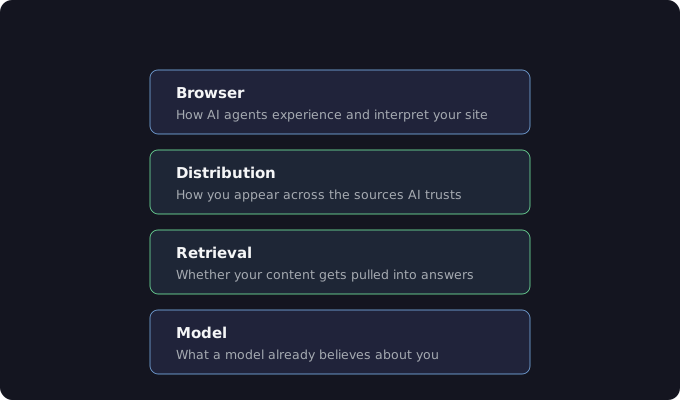
The Four-Layer Visibility Stack
One of the frameworks we've developed is our Four-Layer Visibility Stack.
It looks at AI visibility across four connected areas:
- Model: What an AI model has learned or appears to understand about a brand.
- Retrieval: Whether relevant content is being found and incorporated into generated answers.
- Distribution: How a brand is represented across the third-party sources that AI systems may rely on.
- Browser: How AI agents interact with and interpret a website when carrying out tasks on someone's behalf.
The framework helps us investigate where visibility problems might originate, rather than assuming every issue can be solved by publishing more content. It's also shaped how we think about the relationship between technical SEO, content, digital PR and the emerging role of AI agents.

Topic-level visibility analysis
We've also developed our own approach to measuring visibility across topics.
Prompt tracking has a role, but recording whether a brand appears in a predefined set of questions only gives you part of the picture. We wanted a broader understanding of how AI systems represent a brand across an entire subject area.
Our topic-level analysis helps us identify where a brand appears to have authority, where competitors are better represented and which gaps deserve further investigation. That gives us a more useful starting point for strategy than simply reporting how many times a brand appeared in a collection of prompts.
Research and reporting
Behind the scenes, we've built our own research engine using GPU infrastructure within our Google Cloud environment. It supports our content research and briefing processes, allowing us to combine traditional search data with analysis designed around generative search.
We've also developed Evolv Reports, our reporting environment that brings together Search Console data, rankings, AI Overview presence and LLM visibility. For clients, that means being able to examine traditional and AI search performance alongside one another, rather than treating them as unrelated reporting exercises.
There's still a lot we want to develop, and I suspect that will always be the case. The industry is changing too quickly for any methodology or platform to remain static. But building our own technology means we can keep adapting our approach as we learn more.

The people who helped get us here
When I look back over my career, one of the things that stands out is how much I've learned from the people around me.
I've worked across different agencies, with different teams, leaders and clients. I started out learning from people with far more experience than I had, and eventually found myself in a position where I could build teams, develop people and help them progress in their own careers. That became one of the most rewarding parts of the job. It's also something I wanted to carry into Evolv.
When Accelerate closed, I hoped that building another business might eventually create opportunities for some of the talented people I'd worked with there. I'm pleased we've already been able to make that happen.
Working with familiar faces again, people I know and trust, has been one of the most rewarding parts of the first year. To everyone I've worked with throughout my career, particularly those from Accelerate, thank you. The experience, knowledge and relationships I've built over the years have all contributed to what Evolv is today.
To the clients and stakeholders who supported us from the beginning, and especially SUSE for backing us early on, thank you for putting your trust in what we were building. And to Jeeranan, thank you for everything behind the scenes. Starting a business brings plenty of uncertainty, and having that support has meant more than I can properly put into words.

Looking ahead
If you'd asked me a year ago where Evolv would be today, I'm not sure I'd have predicted how well things would go. I'm proud that we took an idea, developed the technology behind it and turned it into a business. I'm proud of the relationships we've built and the work we're doing with clients.
But what matters most to me is that we're starting to build the kind of agency I wanted Evolv to become. One where we're involved in the thinking as well as the execution, where we continue developing our own approaches and where the quality of the work matters more than the size of the business.
I don't have ambitions to build the biggest agency in the industry. I'd rather build one that does work we're proud of, with people we enjoy working with, and where clients see real value in having us involved.
There's still a huge amount to learn about how AI will change search, and I'm sure the next twelve months will bring challenges we haven't anticipated. But that's also what makes this such an interesting time to be working in the industry.
A year ago, I had a young family to support, an idea I believed in and no guarantee that any of it would work. Today, I'm glad I took the chance.
To everyone who's been part of Evolv's first year, thank you. Here's to year two.